
Why Should Engineers Design Post-Installed Rebar Connections for Fire Exposure?
How connection type, concrete cover, embedment depth, fire duration, and qualified bond data affect fire-safe concrete-to-concrete design
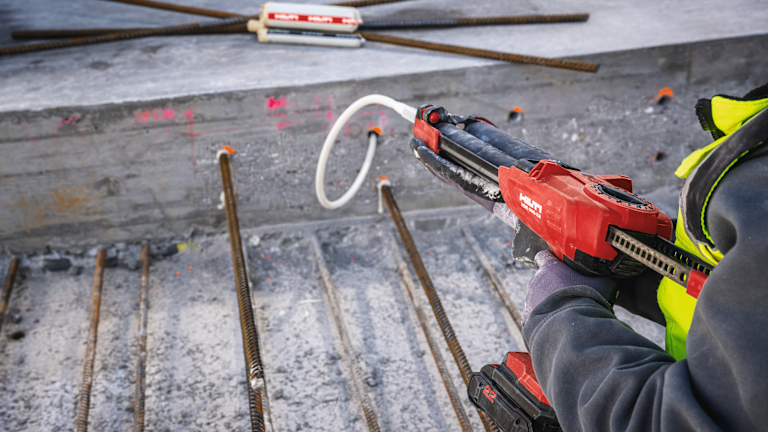
How connection type, concrete cover, embedment depth, fire duration, and qualified bond data affect fire-safe concrete-to-concrete design
Post-installed rebar introduces a third element in connections – the adhesive. Because of this, we must design for the required fire exposure using product-specific, temperature-dependent bond data; code-minimum concrete covers for cast-in reinforcement alone is not sufficient.
Engineers should therefore evaluate the connection geometry, time-temperature profile, embedment depth, fire duration, and the applicable post-installed adhesive ICC-ES report before selecting the right adhesive for fire-exposed connections. As your trusted partner, we make this process smooth with code compliant products and easy-to-use software PROFIS Engineering.
1. Why Does Fire Design Matter for Post-Installed Rebar?
Fire incidents remain a significant threat to life and property across all types of structures, with the potential to compromise the stability of concrete elements and lead to partial or complete collapse. Structural fire safety is therefore a fundamental requirement in major building codes including the National Building Code of Canada. These codes prescribe minimum fire resistance durations for structural components and their connections to support safe evacuation, emergency response, and controlled fire suppression among other fire safety objectives.
The Objective of the IBC: “Establish the minimum requirements to provide a reasonable level of safety, health and general welfare through structural strength, means of egress, stability, … and for providing a reasonable level of life safety and property protection from the hazards of fire, … and to provide a reasonable level of safety to firefighters and emergency responders during emergency operations.”
The 2025 National Building Code of Canada Division A, Article 2.2.1.1., Objective OS1 — Fire Safety states regarding the objective of the NBC:“Limit the probability that, as a result of the design or construction of the building, a person in or adjacent to the building will be exposed to an unacceptable risk of injury due to fire. The risks of injury due to fire addressed in this Code are those caused by…collapse of physical elements due to a fire or explosion.
Post-installed reinforcing bar systems are widely used to connect concrete elements cast at different times, allowing new and existing members to be designed to act monolithically. They provide reliable, efficient, and cost-effective solutions for both planned and unforeseen construction needs. In many cases, post-installed reinforcing bars are used to address unplanned situations where cast-in dowels, starter bars, or couplers were missed, misplaced, or require modification. They may also be used as part of planned construction sequences to improve constructability, accelerate the workflow, or support strengthening and retrofit applications in buildings and civil infrastructure.
While building codes provide established guidance for the fire design of conventional reinforced concrete systems with cast-in-place reinforcing bars, typically through tabulated data or simplified methods, post-installed reinforcing bar systems require additional design considerations and engineering judgment. This is mainly due to the distinct temperature-dependent bond behavior of injection mortars compared with concrete and reinforcing steel. It remains the structural engineer’s responsibility to verify that post-installed reinforcing bar systems meet the applicable fire resistance and fire safety requirements for the project.
The following sections outline the key design considerations and procedures for fire design of post-installed reinforcing bar applications.
2. What Types of Post-Installed Rebar Connections Require Fire Design?
Post-installed reinforcing bar applications used for concrete-to-concrete connections can be broadly classified into two main categories: lap splice/member extension applications and reinforcing bar anchorage/ joint applications.
In lap splice or member extension applications, post-installed reinforcing bars are typically used to extend existing slabs, beams, walls, or columns. In these applications, the post-installed bars are spliced with existing or new reinforcement so that the new concrete element can act as a continuation of the existing member. These applications are often referred to as 180° connections.
In reinforcing bar anchorage or joint applications, the post-installed reinforcing bars are developed into an existing concrete member to connect a new element, such as a slab-to-wall, beam-to-wall, column-to-slab, or wall-to-foundation connection. These applications are often referred to as 90° connections. In this context, this use of the term “anchorage” refers to the development or termination of reinforcing bars within concrete, rather than anchorage design under CSA A23.3 Annex D or ACI 318 Ch 17.
Figure 2 illustrates the general classification of post-installed reinforcing bar applications.

3. How Does Fire Affect Cast-In and Post-Installed Rebar Differently?
The behavior of post-installed reinforcing bars under fire exposure differs from cast-in-place reinforcing bars primarily because the load transfer depends on the temperature-dependent bond performance of the injection mortar. While cast-in-place reinforcing bars rely on the bond between reinforcing steel and concrete, post-installed reinforcing bars introduce an adhesive or cementitious mortar layer between the reinforcing bar and the surrounding concrete.
For most organic-based injection mortars, bond strength can decrease significantly as temperature rises, and the degree of reduction is highly product-specific. Most injection mortars on the market are classified as organic based on their chemical composition. In contrast, HIT-FP 700 R is an inorganic, cementitious adhesive that behaves more like concrete under elevated temperatures. As illustrated in Figure 3, the reduction in bond performance of injection mortars under elevated temperatures can differ substantially from the behavior of reinforcing steel and concrete. Therefore, understanding the time–temperature-dependent bond-strength reduction of the specific injection mortar is essential for fire design of post-installed reinforcing bar applications.
Hilti’s HIT-FP 700 R is an injectable inorganic cementitious adhesive developed for fire-resistant structural reinforcing bar connections. Compared with conventional organic injection mortars, it is designed to provide improved bond performance at elevated temperatures, where supported by the applicable product assessment and technical data.

4. Why is the Minimum Concrete Cover Based on Codes Not Enough?
The IBC and the National Building Code of Canada provides guidance on the minimum concrete cover based on the fire resistance rating and the type of concrete. For example, as shown in Figure 3: NBC Table D-2.2.1.-B, a 2-hour fire rating using Type S concrete requires a minimum cover of 25mm and Figure Figure 4: ACI-216 Table 4.3.1.1 a 2-hour fire rating of Carbonate concrete requires a minimum cover of ¾ inch.

However, it is critical to note that these concrete cover tables were developed for cast-in-place rebar, not post-installed rebar. This distinction matters because of how heat affects different materials. As seen earlier in Figure 2, beyond 400°C or 750°F, organic mainstream adhesives lose their bond strength entirely. In contrast, specialized products like FP 700 R retain much of their bond strength even past up to 598°C or 1108°F.
Relying on code-minimum cover for post-installed rebar can therefore be dangerous. During an ASTM E119 fire test, a slab with a 25mm (1 inch) concrete cover and a 2-hour fire rating will reach internal temperatures of approximately 580°C or 1076°F (Figure 5). While this is perfectly fine for cast-in-place steel and concrete, it far exceeds the failure point of organic adhesives. To keep the internal temperature below 150°C or 302°F (to ensure the post-installed organic adhesive can still hold a safe load) a significantly thicker concrete cover of 125mm (or roughly 5 inches) would actually be required.

Three variables primarily control the temperature along a post-installed rebar connection: concrete cover, the shortest distance from the exposed concrete surface to the bar; embedment depth, the installed length of reinforcing bar bonded into the existing concrete; and fire exposure duration, the required time under the applicable standard fire curve. For post-installed rebar applications using lap splices, the temperature distribution along the embedment length is usually constant, for most common scenarios (see Figure 6a). In end-anchorage applications, temperature distribution usually varies along the embedment depth of the post-installed rebar (see Figure 6b).

5. How Are Fire-Rated Post-Installed Rebar Connections Designed?
In 2022, the International Code Council Evaluation Service (ICC-ES) updated the Acceptance Criteria for Post-installed Adhesive Anchors in Concrete Elements (AC308) with testing provisions for fire evaluation of post-installed reinforcing bars designed for development. These provisions can be used to design post-installed reinforcing bars for a specific fire rating. Hilti HIT-RE 500 V3 has been evaluated per these provisions, and the product evaluation report ESR-3814 has been updated with data to design post-installed reinforcing bars for development in conjunction with a specific fire rating.
In late 2025, the definition of “adhesive” outlined by AC308 was updated to include inorganic adhesives. ICC-ES ESR-5891, issued in 2026, evaluates Hilti HIT-FP 700 R as an injection system for post-installed reinforcing bar connections in cracked and uncracked concrete with approvals for seismic.
Design of lap splice or extensions (180° Connections) under fire exposure:

Design of Joints (90° Connections) under fire exposure:
Unlike extensions, joints have a variable temperature profile along the length of the embedment depth. The fire safe development length is calculated by taking an integral of the reduced bond strength under fire multiplied by the bar area along the length of the embedment.

6. How does one Design Concrete to Concrete Connections in PROFIS?
To start with your fully code-compliant and safer concrete-to-concrete connection designs, use Hilti’s proprietary software PROFIS ENGINEERING for quick, efficient and reliable solutions. With its advanced post-installed rebar module, PROFIS now incorporates latest fire simulations with various parameters allowing designers to evaluate more realistic rebar and injection adhesive performances under elevated temperatures. PROFIS allows you to choose fire exposure durations up to 360 min for any post-installed rebar application, or the user is allowed to give manual input of rebar temperature as well. The software enables quick comparison of different qualified injection adhesives under multiple load actions (static, seismic, and fire) and instantly shows the governing case, saving time and improving accuracy.
7. Hilti SPEC2SITE™ SOLUTIONS
Since Hilti offers a range of qualified solutions for structural post-installed rebar connections under fire exposure, we want to make it easy for our users to navigate through and select the best solution for their applications. We do this by offering our SPEC2SITE™ solutions making your project applications more productive, safer and more sustainable. SPEC2SITE™ solutions offer a comprehensive portfolio to cover fire design needs for post-installed applications together with differentiated design methods, qualified products, design software, services, literature content in engineering center and our direct sales force (see Figure 9).

8. Frequently Asked Questions
Can I use HIT-FP 700 R for an anchoring application?
Hilti’s HIT-FP 700 R has been tested for use with the reinforcing bar development length provisions of the code available in ACI 318-19 Chapter 25 and CSA A23.3 -19 Chapter 12. It has not been tested per a test method to make its design compatible with the post-installed anchoring provisions of ACI 318-19 Chapter 17 or CSA A23.3-19 Annex D.
Should I replace RE-500 V3 with FP-700 R moving forward?
Not necessarily. Both HIT-FP 700 R and HIT-RE 500 V3 have been tested for use in fire-rated reinforcing bar connections, and each have benefits depending on the application. HIT-RE 500 V3 is a great option in connections where you have a variable temperature gradient along the embedded length such as post-installed rebar installed in a joint connection and may even have a lesser embedded length than HIT-FP 700 R in the same connection. HIT-FP 700 R demonstrates its benefit in extension type applications where the full embedded length is exposed to the same elevated temperature. In summary, when there is a larger concrete cover and protection from the fire, HIT-RE 500 V3 may still be the option with the smaller development length.
Why has fire design not been addressed previously?
Until late 2022 there was not a test method available to evaluate adhesive performance when exposed to heat. However, with the prevalence of post-installed connections in construction due to their ease of use and flexibility, the International Code Council Evaluation Services (ICC-ES) introduced a new optional testing protocol within AC308 for manufacturers to test for the “Bond Stress vs. Temperature of Post-installed Reinforcing Bar Applications Subject to Elevated Temperature/Fire” curve for adhesives exposed to heat in post-installed reinforcing bar connections.
Can HIT-FP 700 R and HIT-RE 500 V3 be designed in masonry fire-rated walls?
While masonry fire-rated walls are common, neither HIT-FP 700 R nor HIT-RE 500 V3 have been tested for use in masonry construction. They are currently only tested for use in cracked and uncracked concrete.
What is the load combination that I should be using when performing a fire design?
The load combination for design is up to the engineer of record and local rules and regulations. ASCE 7 does offer a load combination for extraordinary events like fire which provides for half of the normal live load and some considerations of loads during the fire (Ak). It is up to the EOR (Engineers of Record) whether this is acceptable for their structure.