
Choosing a silica dust extractor for concrete work
Understand silica dust risks, OSHA requirements, and how to select the right dust extractor for concrete applications.

Updated August 2026
Choosing a silica dust extractor for concrete work comes down to three variables: filtration class (where OSHA 29 CFR 1926.1153(c)(1) Table 1 calls for a dust collector, it sets 99% or greater efficiency, and it names a HEPA-filtered vacuum for cleaning drilled holes), airflow matched to the specific tool and task, and filter cleaning that maintains suction across a full shift without operator intervention. Table 1 is the compliance anchor – it specifies which engineering controls apply to each concrete task, and your extractor configuration must align with those requirements. Hilti’s dust extractor and matched attachment system is a reference example of an integrated, task-matched approach to dust extraction for concrete work.
IN THIS DOCUMENT
What does OSHA 29 CFR 1926.1153(c)(1) Table 1 actually require from a dust extractor?
How does the task type change which dust extractor configuration you need?
How do hose size, cord length, and onboard power affect what you can connect?
Why does filter-cleaning method affect suction consistency across a full shift?
How do portability, storage, and jobsite mobility factor into the right choice?
What does an integrated tool, shroud, and extractor system change on a concrete jobsite?
Which extractor setup fits a commercial crew, a facilities team, and a smaller contractor?
TL;DR
Ready to configure your dust control system for concrete work?
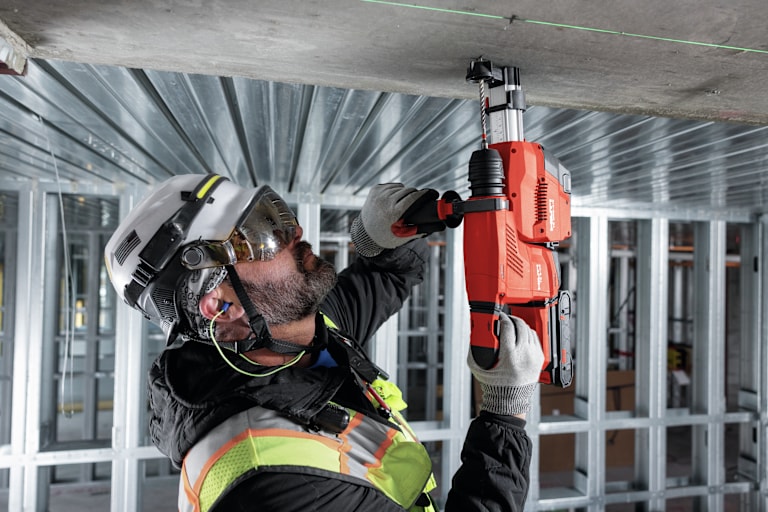
OSHA 29 CFR 1926.1153 sets the permissible exposure limit (PEL) for respirable crystalline silica at 50 micrograms per cubic meter as an 8-hour time-weighted average (TWA). Table 1 of that standard specifies engineering controls task-by-task – it does not leave the configuration to judgment. Two routes run through it. Drilling and grinding call for a commercially available shroud or cowling plus a dust collector with a filter of 99% or greater efficiency; drilling adds "Use a HEPA-filtered vacuum when cleaning holes." Concrete sawing calls for water: a saw with an integrated water delivery system that continuously feeds water to the blade, with no dust-collection alternative listed. Grinding outdoors, for uses other than mortar removal, can take either route. The task-by-task detail is in the table further down.
Three Important OSHA Table 1 Requirements Often Overlooked
Follow Manufacturer Instructions
Operate and maintain tools per manufacturer guidelines to help minimize silica dust emissions.
Respiratory Protection May Apply
Some tasks require APF 10 or APF 25 respirators in addition to engineering controls for OSHA compliance.
Additional OSHA Control Requirements
Indoor tasks require exhaust ventilation, while wet methods require sufficient water flow under OSHA rules.
How does the task type change which dust extractor configuration you need?
The right extractor configuration depends on whether you are drilling, grinding, cutting, or performing cleanup – each generates dust through a different mechanism and requires a different attachment and airflow profile.
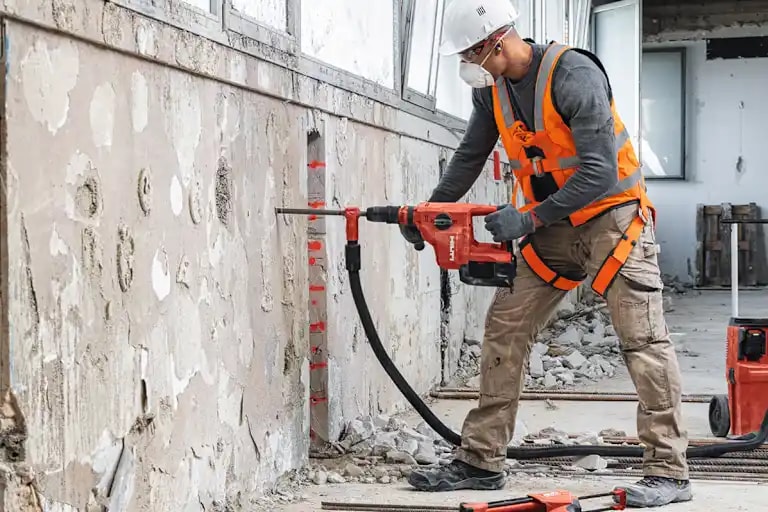
Drilling into concrete (anchor holes, core drilling) produces a concentrated plume at the drill collar, and there are two alternative configurations. A hollow drill bit – the Hilti TE-CD (SDS Plus) or TE-YD (SDS Max) – evacuates dust up through the bit shank to an extractor connected by hose; Hilti lists a vacuum as required for these bits and supplies the HDB connector. The Hilti DRS on-board Dust Removal System captures at the collar from a module mounted on the tool, with no external hose; Hilti states the TE DRS-4-A T1 is "OSHA 1926.1153 table 1 compliant, with filter cleaning mechanism." Table 1 sets no airflow number for drilling – it defers to the tool manufacturer’s recommended figure, so source that from the tool documentation rather than a rule of thumb.
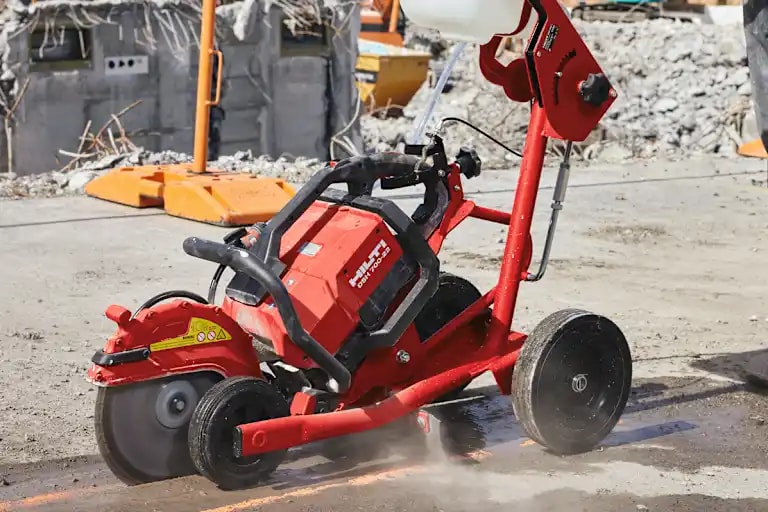
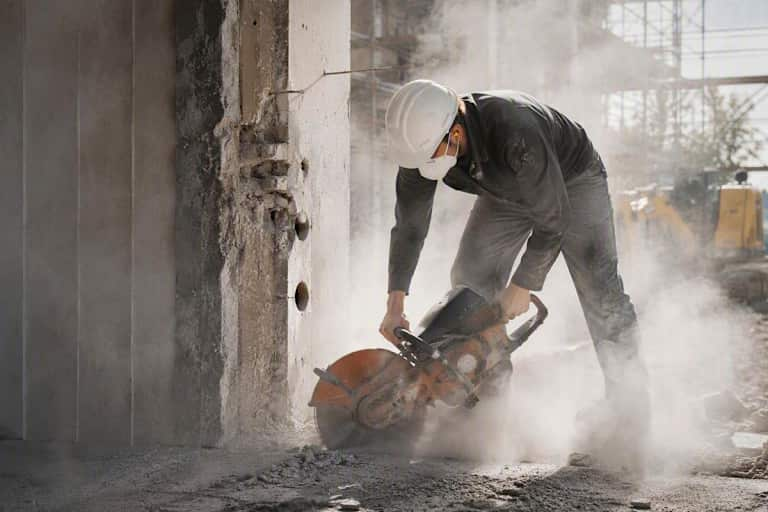
Cutting concrete with a handheld saw or electric cutter leaves the least latitude: Table 1 specifies integrated water delivery to the blade and lists no dust-collection alternative for concrete. That changes the extractor's role downstream – wet pickup and slurry removal rather than airborne capture. Crews that need to cut dry are outside Table 1, under the standard's alternative exposure control methods and their own assessment obligations. Hilti builds the DCH 300-X for both wet and dry operation and supplies a water kit; Hilti makes no Table 1 statement for that cutter, so confirm the configuration against the tool documentation.
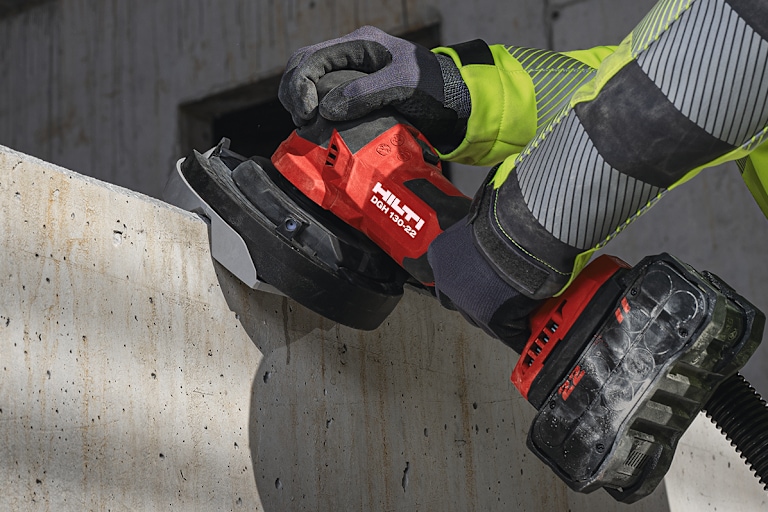
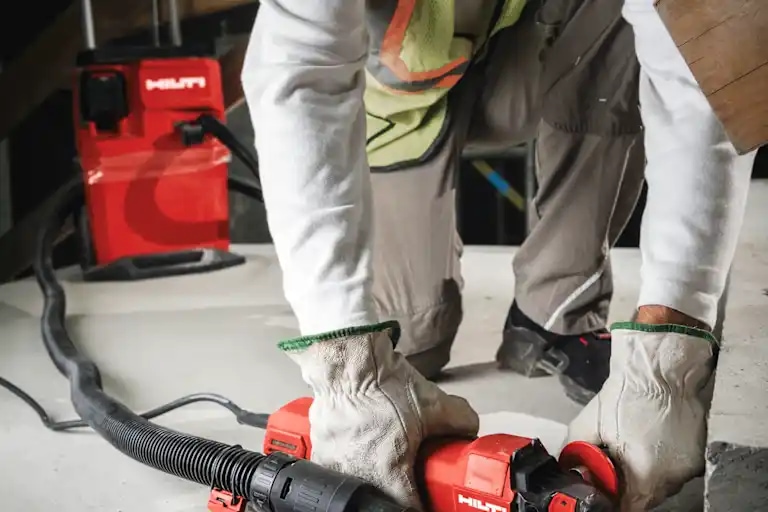
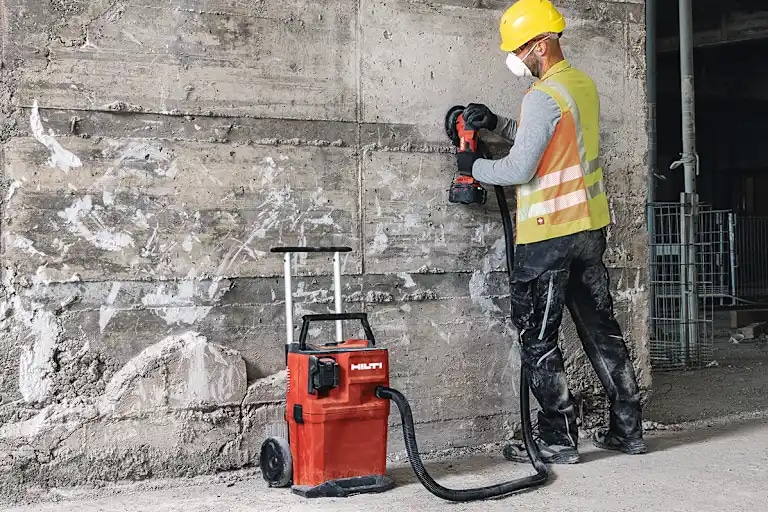
Grinding and surface preparation produces the highest sustained dust load of any concrete task, and it is the one task where Table 1 puts a hard number on airflow: 25 CFM per inch of wheel diameter, so 125 CFM for a 5-inch wheel and 175 CFM for a 7-inch. Wheel diameter, not extractor size, sets that floor. Filter cleaning matters more here than anywhere else, because fine concrete dust loads filter media rapidly and suction drops as it does.
Cleanup and general area vacuuming sits outside Table 1 but is still regulated: §1926.1153(f) restricts dry sweeping and dry brushing where wet sweeping, HEPA-filtered vacuuming, or another effective method is feasible, and restricts compressed air for cleaning. Container capacity is the practical variable – it sets how often the crew stops to change a bag on extended cleanup passes.
Application | Primary dust generation mode | Configuration | What the standard specifies | Respiratory protection |
|---|---|---|---|---|
Drilling | Concentrated plume at collar | Hollow bit and hose, or on-board DRS | Table 1: commercially available shroud or cowling; 99%+ filter efficiency; manufacturer-recommended airflow; filter-cleaning mechanism; HEPA-filtered vacuum for cleaning holes | None specified |
Grinding / surface prep | Continuous high-volume fine dust | Commercially available shroud and extractor, or integrated water delivery outdoors | Table 1: 99%+ filter efficiency; 25 CFM per inch of wheel diameter; cyclonic pre-separator or filter-cleaning mechanism. Water delivery is an alternative outdoors for uses other than mortar removal | APF 10 / APF 25 depending on use, duration, and indoor or outdoor work |
Cutting (handheld saw) | Blade-generated plume at guard | Integrated water delivery system | Table 1: continuous water feed to the blade. No dust-collection alternative listed for concrete | APF 10 indoors; outdoors beyond four hours |
Cleanup / area vacuuming | Re-suspension of settled dust | Extractor nozzle or floor tool | Not a Table 1 entry. §1926.1153(f)(1) restricts dry sweeping where a HEPA-filtered vacuum is a feasible alternative | Per the employer's exposure assessment |
Choose a silica dust extractor by matching filtration, airflow, and filter-cleaning capability to the specific drilling, grinding, cutting, or cleanup task and its OSHA requirements.
Choosing a silica dust extractor for concrete work means matching three variables: filtration rated at 99% efficiency or greater where Table 1 calls for a dust collector, airflow suited to the tool and task, and filter cleaning that maintains suction across a shift. OSHA 29 CFR 1926.1153 Table 1 sets the controls task by task – a HEPA-filtered vacuum for cleaning drilled holes, 25 CFM per inch of wheel diameter for handheld grinding, continuous water feed for concrete saws – plus respiratory protection on top for some tasks. Hilti’s extractors and matched attachments are built as one configured system, with the corded VC 150-10 XE (150 CFM, 75 lb dust, 6 gallon water) and the cordless L-class VC 4LX-22 (63.57 ft³/min at hose end) as the published reference points. Match those figures against the requirement for the task before specifying either.
Ready to configure your dust control system for concrete work?
Browse Hilti’s full range of dust extractors and matched attachments – shrouds, on-board DRS systems, water management systems, and hose adapters – in the dust and water management catalog. For application-specific guidance, OSHA compliance resources, and task-by-task dust control recommendations, visit the Pros Know contractor hub. To discuss extractor selection for your specific crew size, task mix, and jobsite configuration, contact a Hilti representative directly – the conversation starts with your tools and tasks, not a product list.
Hose diameter must match the tool’s dust port; a mismatch reduces capture at the source regardless of the extractor’s filtration rating. Hilti supplies application-specific adapters and connectors – the HDB connector for hollow drill bits, the shroud system for TE drilling and demolition tools – so the connection is matched rather than adapted with third-party fittings.
The onboard outlet enables tool-triggered activation: the connected tool’s draw starts the extractor automatically. That outlet has its own ceiling – Hilti publishes a maximum socket output of 11 A on the VC 150-10 XE – so two checks belong at the configuration stage: the tool’s draw against the socket rating, and the combined draw of extractor and tool against the circuit breaker, typically 15A or 20A. Exceeding either interrupts extraction mid-task.
Cord length and hose length work against each other. Longer hose runs introduce friction loss that reduces suction at the attachment point, so the extractor wants to sit close to the work – but it also has to reach a circuit, and the cord decides how close it can get. Where circuit access is limited, a cordless unit removes the constraint at both ends.
Fine concrete and silica dust is cohesive – it packs into filter media quickly and increases back-pressure, which reduces airflow at the shroud. On heavy-dust tasks like grinding, suction can drop measurably within a short period of continuous use if the filter is not cleared.
Manual cleaning requires the operator to stop, open the extractor, and tap or brush the filter – an interruption that also creates a secondary exposure risk, since accumulated silica-laden dust can become briefly airborne during handling.
Automatic filter cleaning – using a pulse or reverse-jet mechanism – addresses both problems. The mechanism delivers a brief reverse airflow pulse that dislodges accumulated dust from the filter media into the collection container. Implementations differ in when the pulse fires: some run on a fixed interval, others adapt to filter loading. The Hilti VC 150-10 XE is the adaptive case: Hilti describes its filter cleaning as maintaining consistent suction performance and activating only when necessary, which is designed to remove the mid-task filter stop from the work cycle. Hilti lists the unit at 150 CFM with a 75 lb dust capacity and a 6 gallon water capacity.
The pulse discharges dust into the collection container rather than requiring the operator to open the unit mid-task, which is the exposure step manual cleaning introduces. Filter service intervals vary with task intensity and dust load – consult the product documentation for the model in use.
On multi-floor projects the extractor moves with the crew, so cord wrap, hose storage, and body profile decide how much of the shift goes into setup and pack-up. A narrow-profile unit passes through standard doorways and fits into elevators; a wider stance offers more stability on uneven subfloors. These are site-layout trade-offs rather than quality differences.
Onboard storage for shrouds, adapters, and spare bags keeps the system complete when the extractor moves. A crew that arrives without the correct shroud has a control gap, not just an inconvenience – Table 1 names a commercially available shroud as part of the required configuration.
For areas without reliable circuit access – scaffolding levels, remote floor plates, outdoor flatwork – a cordless unit removes the constraint entirely. Hilti lists the VC 4LX-22 on the Nuron platform as an L-class extractor with an air flow at hose end of 63.57 ft³/min, for cleaning, drilling and breaking, wood sawing, light cutting and grinding up to 5 in, drywall and wood sanding, wet coring, and socket cutting. Container capacity is SKU-specific – 15 l on the T15, 8 l on the T8. Where a task falls under Table 1, check the published airflow figure against the requirement for that task before specifying any unit.
The question for a concrete crew is not filtration specs in isolation – it is how well extractor, tool, and attachment connect as a configured system.
Filtration determines what an extractor does with dust once it arrives; the attachment determines how much of it arrives at all. A shroud that does not seat squarely against the work surface, or a hose whose diameter does not match the tool’s dust port, reduces capture at the source no matter how the filter is rated. Table 1 sits on both sides of that line: it specifies the filter and the airflow, and it specifies a commercially available shroud.
Hilti dust extractors are designed to pair with Hilti rotary hammers (TE series), concrete grinders (DGH series), and concrete cutters (DCH series) through matched shrouds, the DRS on-board system, and the Nuron cordless platform, with hose ports, tool-trigger connections, and shroud diameters specified together. For a crew already running those tools, that keeps the connection within one documented set and removes the adapter step from the configuration. It is a workflow point rather than a filtration claim – the 99%-efficiency threshold is the same whichever extractor meets it.
Commercial crew running multi-tool production drilling and anchor setting: A corded Hilti VC 150-10 XE per tool station – 75 lb dust capacity, an 11 A integrated socket, adaptive filter cleaning – keeps the filter-maintenance stop out of the drilling cycle. Table 1 separately requires a HEPA-filtered vacuum for cleaning drilled holes; Hilti sells a 99.97%-efficiency HEPA filter for the VC platform, so specify it alongside the extractor rather than assuming it is included.
Facilities maintenance team working in occupied buildings: Intermittent drilling, anchor replacement, and surface repair in occupied space raise the bar on both dust control and cord management. A cordless Hilti VC 4LX-22 on the Nuron platform removes the trip hazard and works where there are no dedicated circuits; Hilti lists it for drilling and breaking, wet coring, socket cutting, and cleaning. Two provisions bite harder in this setting: §1926.1153(c)(2)(i) requires a means of exhaust for indoor and enclosed-area tasks – a site provision, not a tool one – and any handheld grinding brings the 25 CFM per inch threshold and an APF 10 respirator indoors beyond four hours. Replace and close the collection bag before relocating between rooms.
Smaller specialty contractor handling exterior flatwork, occasional cutting and grinding: One corded wet/dry extractor covers grinding, cleanup, and slurry pickup. Two requirements shape the specification before a model is chosen: wheel diameter sets the airflow floor at 25 CFM per inch, and concrete cutting is not an extractor decision at all – Table 1 specifies a saw with integrated water delivery, leaving the extractor to slurry pickup afterwards. The Hilti VC 150-10 XE publishes 150 CFM with 75 lb dust and 6 gallon water capacity; match that airflow figure against the wheel diameter the crew actually runs.
These are example configurations – actual selection should account for task frequency, crew size, available circuit capacity, and specific tool compatibility. For crew-specific configuration support, consult Hilti’s dust and water management catalog or speak with a Hilti representative.