
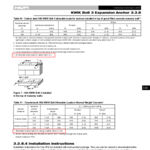
Can I know how much factor of safety is there in Load Tables for Hilti Kwik HUS EZ Anchors embedding in Grout Filled Masonry. Usually there is a safety factor of 4 or 5 and some anchors (Like KB3) have this mentioned in their load chart as foot notes but I am not seeing that for HUS EZ Anchor.
Hi Tahir,
There is no safety factor applied to the design strength loads published for the KH-EZ Screw Anchor starting on page 73 of the Masonry Technical Guide data because this data utilizes the LRFD design methodology. In 2020 and 2021, the International Code Council Evaluation Service (ICC-ES) passed significant revisions to Acceptance Criteria AC58 for Adhesive Anchors into Cracked and Uncracked Masonry, AC01 for Mechanical Anchors in Cracked and Uncracked Masonry, and AC106 for Predrilled Fasteners (Screw Anchors) in Masonry Elements to help correct the outdated methods for testing and designing post-installed anchors into masonry.
Before the recent revisions to the acceptance criteria, evaluation method for post-installed masonry connections was to use Allowable Stress Design (ASD). ASD is based on testing post-installed anchors to failure, then applying a global safety factor to reduce capacity of the anchor to an allowable load for design.
The revised testing method in the acceptance criteria has adopted the framework of the Strength Design method from ACI 318 Chapter 17, with only a few modifications specific to masonry base materials, allowing for anchors to be evaluated to separate failure modes rather than ultimate loads. The corresponding design method for post-installed anchors has been revised to the Strength Design (LRFD) method which uses testing to evaluate the multiple failure modes in tension and shear which mirrors the ACI 318 Concrete Capacity Design (CCD) method. The method assigns specific strength reduction factors to each of several possible failure modes, provides predictions for the strength associated with each failure mode, and compares the controlling design strength with factored loads. Engineers can optimize their anchor designs to the controlling failure mode like the current method of anchoring to concrete provisions provided in ACI 318 Chapter 17.
If you have any further questions, please reach out to hnatechnicalservices@hilti.com.
Best,
Mia