
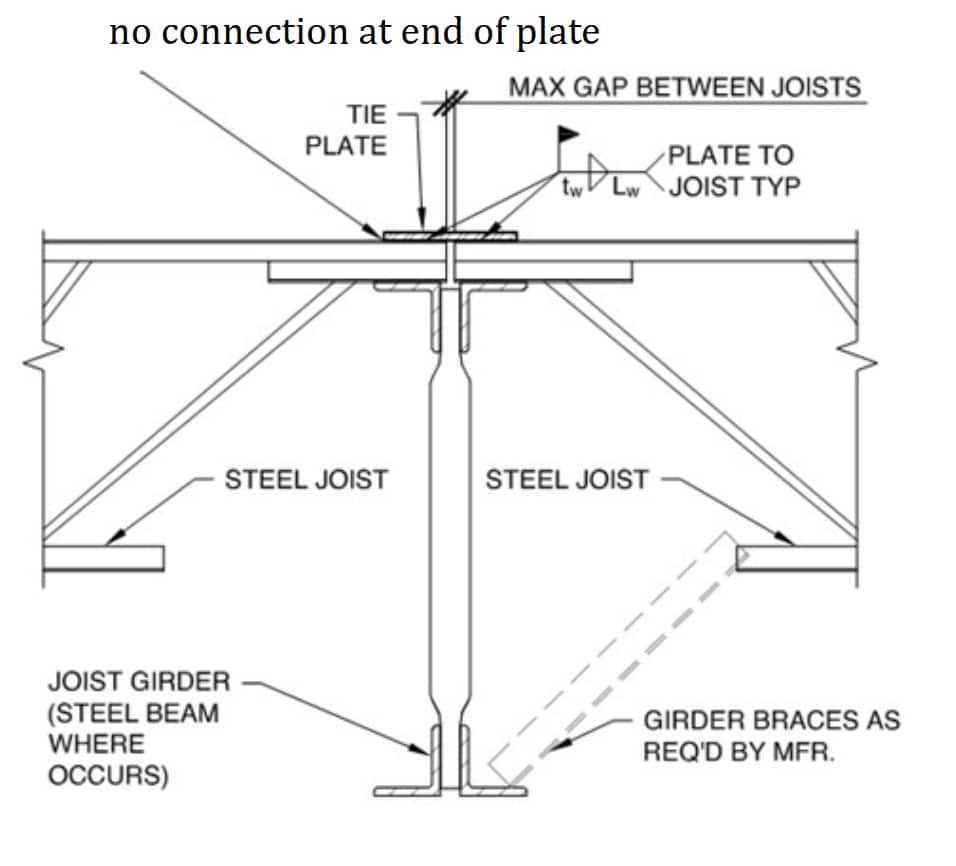
We have a joist-to-joist connection with a 3/8-inch top continuity tie plate welded to the top chord of an open web bar joist. The joist top chord thickness is 1/4 inch. Metal deck will be attached at this location.
Because the 3/8-inch continuity plate is welded to the joist top chord, our intent is for the deck fastener to attach to the continuity plate, and we are not relying on the fastener to develop connection directly into the underlying joist top chord.
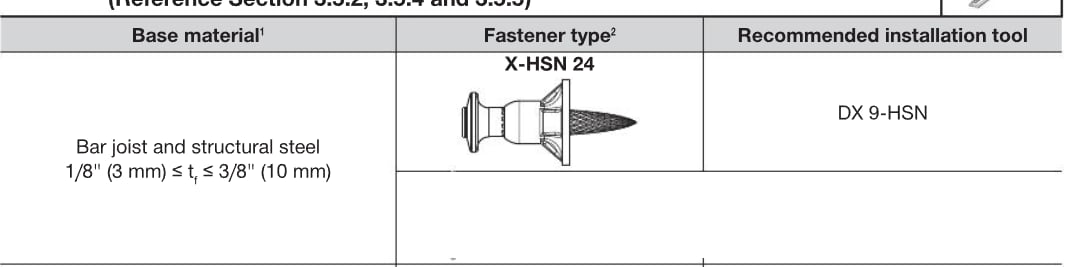
Can the X-HSN 24 be used in this condition by treating the 3/8-inch continuity plate as the effective base material, or does the presence of the underlying 1/4-inch joist top chord make this an unsupported 5/8-inch total steel thickness condition for the X-HSN 24?
Also, is there anything about the installation mechanics of the X-HSN 24 that requires penetration into the underlying joist top chord, rather than only into the welded continuity plate?
Hi Phil,
Thank you for calling today. As we discussed, I am providing an email follow-up elaborating on our phone call.
Per our conversation, it appears that the condition is two materials welded together such that the connection is, from top-down, Deck to 3/8" Plate to 1/4" Joist. In general, the use of two materials instead of one solid base material would be outside of Hilti’s published testing. In the case that the plate is sufficiently welded such that, by the judgement of the Engineer of Record, there is no meaningful gap between the base materials, use of the X-ENP 19 may be more appropriate due to the increased total thickness (X-ENP 19 is for base material thicknesses of ¼” or greater while X-HSN 24 has a range of 1/8” < t < 3/8”). Creation of a mock-up or on-site testing may be advisable to inspect if the fastener is properly driving into/through the materials without causing gaps or dislodging the tie plate.
In cases where the plate overhangs and is not in direct contact with the joist (one layer condition as opposed to two), if the plate itself is 3/8” thick and of an appropriate material, the shear connection of that fastener to the plate should still be valid when installed properly. The base material does not necessarily have to be a joist to get proper installation (end angles, beams, etc. are also suitable). However, the Engineer of Record would need to make the judgement regarding load path and how the diaphragm layout itself works in such a case.
Ultimately, the decision of fastening is at the discretion of the Engineer of Record.
Hope this helps!
Regards,
Riley Barnes
Technical Services | Technical Support Engineer
Hilti North America
7250 Dallas Parkway | Suite 1000
Plano, Texas 75024
P 877-749-6337
E hnatechnicalservices@hilti.com