I am a structural engineer and was designing an adhesive anchor for a project and wanted to compare Simpsons products and Hilti products to give our clients some options. When I was comparing the two, I found that between the Simpson anchor design program and Hilti Profis, Hilti Profis had a 23% reduction in steel capacity when looking at a rebar anchor. I took a deeper look into the two and even looked at the ESR reports (ESR-4057 and ESR-3814) and found these following differences: Simpson uses an ultimate tensile strength of 90ksi whereas Hilti uses 80ksi. Secondly Simpson uses a phi factor of .75 for tensile strength whereas Hilti uses a phi factor of .65. Could you provide some information on what Hilti considers ductile steel vs brittle steel according to ACI 318-19 17.5.3(a) and why a phi factor of .65 is used? Is there a reason why Simpson would use 90ksi vs 80ksi ultimate tensile strength? I am just trying to figure out why there is a big reduction in tensile strength between Simpson and Hilti. Any information would be helpful.
Hi Matthew,
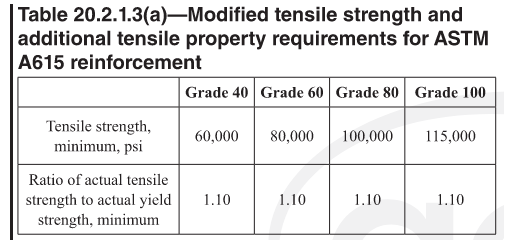
ACI 318-19 added a table that shows modified tensile strengths for ASTM A615 (see attached.) Due to this change, ICC ESR-3814 was updated to reflect the 80 ksi per the code. ASTM A706 Grade 60 is also 80 ksi steel strength, per the standard.
Technically, ASTM A615 bars are ductile elements. However, because the standard does not reference elongation and area reduction, ICC-ES requires that brittle phi factors be used for anchoring-to-concrete design calculations. Due to this, Hilti uses 0.65 for ASTM A615 bars rather than 0.75.
Regards,
Dani