
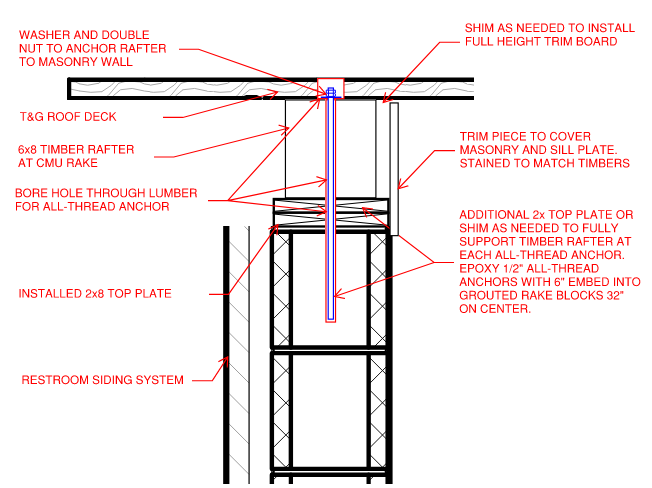
A contractor neglected provide the detailed anchoring for a timber rafter which is running parallel and directly over the top of a section of CMU wall. Their proposed fix is to drill holes top down through the wood deck, timber and into the grouted CMU. Would using a Hilti adhesive to anchor the threaded rods in this condition be feasible? The timber is about 8” deep plus the 3-inch top plate. Please see attached detail. Thank you
Hi Matt,
Generally, Hilti’s ultimate adhesive anchor systems that have published testing and ICC Evaluation Service Reports for grout-filled CMU include the HIT-HY 200 V3 (ESR-4878) and the HIT-HY 270 (ESR-4143) as shown in the Chemical Anchor Selector Chart. Notably, this only supports embedment that is done in the CMU; use of the wood as a contributing base material for the adhesive would be outside of Hilti’s published testing data. Impact of the space created between the embedded anchor and the loading would be at the evaluation of the Engineer of Record on the project.
Ultimately, decision of anchorage is at the discretion of the Engineer of Record. For additional questions, please reach out to hnatechnicalservices@hilti.com
Kind regards,
Sinan
Sorry, my question was not regarding the adhesive being able to bond to the wood, but just the installation feasibility of drilling, cleaning out the hole in the grout filled CMU, and injecting the adhesive, all through the long hole through the decking, timber, and top plate. It would a hole over 12 inches long to the top of the CMU.