

Designing for Yield Based on Anchoring-to-Concrete Provisions
The American Concrete Institute (ACI) standard ACI 318, Building Code Requirements for Structural Concrete, includes provisions to design cast-in reinforcing bars for “development”, i.e. embedding a bar deep enough to “develop” the yield strength without splitting failure occurring. “Splitting failure” refers to cracking and splitting in the concrete around bars in tension. Post-installed reinforcing bars have typically been designed using ACI 318 anchoring-to-concrete provisions, which consider various possible anchor failure modes rather than designing the bars to yield. This article expands the discussion of a design concept introduced in an ACI Structural Journal article by Charney et al. in which anchoring-to-concrete provisions could be used to design post-installed reinforcing bars specifically for yielding.
What is a Post-Installed Reinforcing Bar?
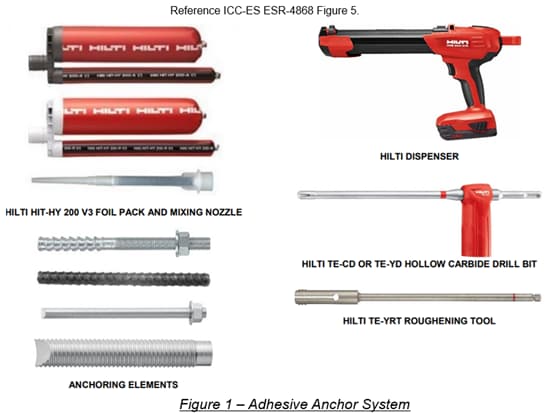
Post-installed reinforcing bars are installed into hardened concrete. The bars are part of an overall system consisting of the bar, an adhesive product, and the installation method. Reference Figure 1. A hole is drilled into the concrete, cleaned, filled with adhesive, and a bar inserted into the adhesive-filled hole. After the adhesive cures, any load applied to the bar is transferred into the concrete via bonding between the adhesive, the bar, and the concrete.



This article, all or in part, has been previously published in the STRUCTURES Magazine, January 2023 issue. It is reprinted with permission.
Check out the article published in STRUCTURE Magazine: Post-Installed Rebar